

16–18 September 2026, Sapienza University of Rome, Italy
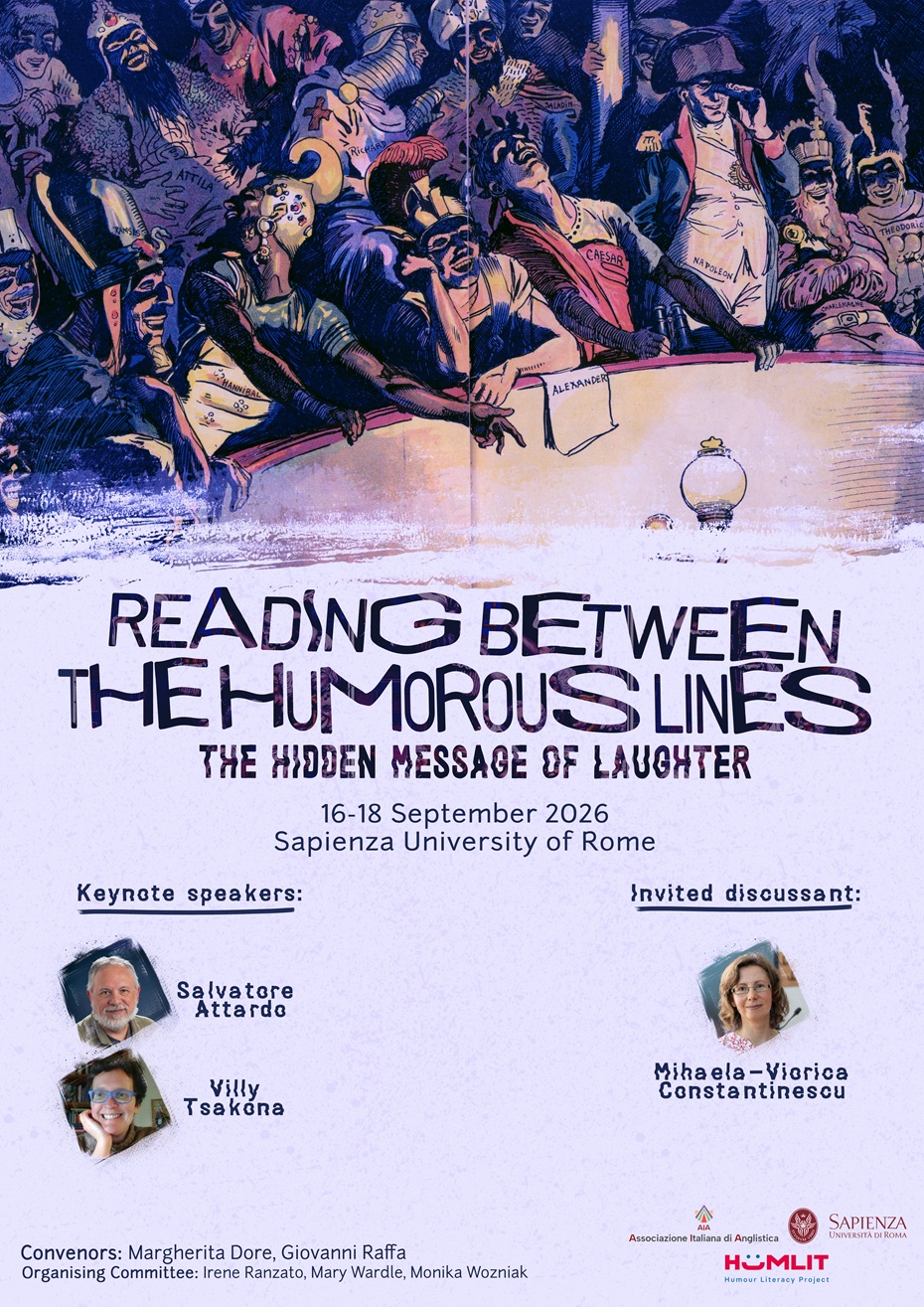
- Description and Call for Papers
While humour is commonly seen as a form of entertainment, its role often extends beyond mere amusement. It can, in fact, be a powerful vehicle for social critique, raising cultural awareness, and fostering civic engagement. However, for every instance of harmless or well-intentioned humour (Raskin 1985; Norrick 1993; Dore 2022 here), there are cases where it acts to reinforce, disseminate, and normalise social discrimination, including racism, sexism, ageism, ableism, and bullying, across a wide range of settings.
Recent research in sociolinguistics has shown that people frequently use humour as a strategy to soften verbal attacks aimed at minorities or marginalized groups. While these jokes may be framed as socially acceptable, they can mask hostile intent and function as a covert form of hate speech (Billing 2005; Lockyer & Pickering 2008; Weaver 2016; Ervine 2019; Tsakona 2019, 2020; Pérez 2022).
Therefore, it is vital for audiences, especially adolescents and young adults, to develop the ability to decipher the discriminatory undertones hidden within seemingly innocent jokes and to build the critical skills needed to challenge and analyse them. It is equally important for the direct and indirect targets of such humour to recognise the value of actively resisting its use in both public and private settings, all while cultivating personal resilience.
With this goal, the conference aims to critically examine real-world examples of these practices and explore a diverse array of contexts, from education and broadcast media to social networks and everyday interpersonal interactions (such as those between doctors and patients or employers and employees) within which humour is employed not only as a means of entertainment, but as a tool for direct and indirect discrimination. Contributors will offer perspectives and tools to identify and address discriminatory humour in social, professional, and educational environments.
To this end, the Scientific Committee would like to consider 20-minute paper proposals engaging with the following key topics (this list is intended to be descriptive, not exhaustive):
- Humour and ableism
- Humour and racism
- Humour literacy and pedagogy
- Smear politics
- Humour and intercultural communication
- Humour and translation
- Humour in educational settings
- Intergenerational differences in humour
- Sexist and feminist humour
- Humour and language ideologies
Humour in the workplace
Proposals will be subject to a double-blind peer-review process. Please send your proposals to BOTH Margherita Dore (margherita.dore@uniroma1.it) and Giovanni Raffa (giovanni.raffa@uniroma1.it)
Please also note that the conference will feature a half-day session dedicated to engaging high school (head)teachers, and potentially students, in a roundtable discussion on Humour Literacy.
This session aims to:
Foster a deeper understanding of the role of humour in social interaction, exploring its key advantages and pitfalls as a communicative tool.
Provide educators and learners with practical tools to recognize and decode humour that perpetuates social inequalities—such as racist, sexist, or ableist content—whether delivered through explicit or implicit means across various channels, including social media.
Empower participants to identify discriminatory messages embedded within humorous discourse.
To achieve this, the seminar will involve the analysis of humorous materials from diverse real-world
contexts, designed to boost engagement and sharpen critical analytical skills.
Working language: English
References
Billig, M. (2005). Laughter and ridicule: Towards a social critique of humour. Sage.
Dore, M. (2022). Standing-up for a Cause. The Cathartic and Persuasive Power of Stand-up Comedy. In R. Bhargava & R. Chilana, (eds.) Punching Up in Stand-Up Comedy Speaking Truth to Power (p. 214-234. Routledge.
Ervine, J. (2019). Humor in contemporary France: Controversy, consensus, and contradictions. Liverpool University Press.
Lockyer, S., & Pickering, M. (2008). You must be joking: The sociological critique of humour and comic media. Sociology Compass, 2(3), 808-820.
Norrick, N. R. (1993). Conversational joking: Humor in everyday talk. Indiana University Press.
Pérez, R. (2022). The souls of white jokes: How racist humor fuels white supremacy. Stanford University Press.
Raskin, V. (1985). Semantic Mechanism of Humour. Reidel Publishing.
Tsakona, V. (2019). Talking about humor, racism, and anti-racism in class: A critical literacy proposal. Bulletin of the Transilvania University of Braşov, Series IV:Philology and Cultural Studies, 12(61)(2), 111-141.
Tsakona, V. (2020). Recontextualizing Humor: Rethinking the Analysis and Teaching of Humor. De Gruyter Mouton.
Weaver, S. (2016). The rhetoric of racist humor: US, UK and global race joking. Routledge.
- Deadlines and fees
Deadlines and fees:
28 February 2026 – Deadline for abstracts (max. 300 words) and biosketch (max. 100 words)
31 March 2026 – Notification of acceptance
16-18 September 2026 – Conference, Sapienza University of Rome, Italy
Early bird registration (by 31 May 2026)
€150 (Professors and Researchers); €100 (HUMLIT Members, PhD students and independent scholars).
Registration is now closed. Thank you.
Regular registration (by 15 July 2026)
€200 (Professors and Researchers); €150 (HUMLIT Members, PhD students and independent scholars).
BA, MA students: free entry but the must email the organisers for reservation by 10 September 2026.
Registration is now closed. Thank you.
- Invited Keynote Speakers
- Salvatore Attardo, Full Professor of Applied Linguistics (English Language) at Texas A&M University–Commerce, USA (https://www.etamu.edu/people/salvatore-attardo/). Professor Attardo is internationally regarded as one of the most prominent figures in the field of humour research. His scholarly work spans a wide range of topics, including pragmatics, semantics, and grammar. At the conference, Professor Attardo will deliver a plenary lecture exploring the complex relationship between humour and political (in)correctness.
This paper examines the multiple layers of meaning presented by humorous acts considered as discursive forms, in dialogical, monological, and polylogual settings. Starting from the dialogical conversation as the “simple form” of interactional performance of humor, a humorous act is seen as a bid to disrupt the dialogic alternation of turns, with the justification that the product is “worth” the time/effort. Monologic modes, such as standup comedy, or videos, or traditional texts, which allow responses only “after the fact” are also seen as essentially promising a Labov-inspired “tellability-plus” performance, i.e., the promise of a sufficient reason to produce the text plus the promise of entertainment/amusement. Finally, exchanges shaped as polylogues are shown to also fit the “tellability-plus" model. However, the meanings of humor are not exhausted by the first round of interactional meanings. Other derived meanings exist as well, such as the presupposition that it is appropriate to joke in that particular moment/situation, that the target of the humor is an acceptable target, and more. This forces a significant broadening of the concept of “meaning” of humor in which its significance is soft-assembled by all the participants, regardless of their status in the exchange.
- Villy Tsakona, Professor of Social and Educational Approaches to Language at the National and Kapodistrian University of Athens, Greece (https://www.ecd.uoa.gr/vasiliki-tsakona/). Her main research interests involve humor research, narrative analysis, political and media discourse analysis, as well as critical literacy theory and applications. She recently co-edited Exploring the Ambivalence of Liquid Racism: In between Racist and Antiracist Discourse (with Argiris Archakis; John Benjamins, 2024) and authored Exploring the Sociopragmatics of Online Humor (John Benjamins, 2024). She is also co-editor of the European Journal of Humor Research.
“Titanic: 2, Rich people: 0”: When online humor goes classist
Villy Tsakona
National and Kapodistrian University of Athens
Classist humor aims to highlight and denounce power inequalities and division between the members of different social classes and is usually premised on status-based stereotypes. It may attack either persons with high social status for their classism or persons belonging to lower social strata for not conforming to middle- or upper-class standards of behavior (Landis-Schiff 1992: 38, Coleman 1993: 118, Davies 2010: 38–39, Attardo 2023: 77-83). The proposed study investigates humorous memes as instances of classist humor denigrating upper-class members for their life-style choices. The data examined pertain to the Titan submersible implosion (July 2023), which led to the death of 5 passengers who could afford an excessive amount of money to visit the wreckage of the Titanic. The analysis reveals that a significant part of these memes humorously targets the passengers and their families via the use of scripts which involve representations of rich people’s values, mentalities, and actions. Through classist humor such scripts are framed as abnormal and are opposed to scripts related to middle- or lower-class values and life-styles, which are framed as normal (on script opposition as the core of humor, see among others Attardo 2023: 42-45). The goal of the study is to bring to the surface discriminatory representations of upper-class members, which contribute to naturalizing classism in a surreptitious manner.
References
Attardo, S. 2023. Humor 2.0: How the Internet Changed Humor. London: Anthem Press.
Coleman, C. M. 1993. Gender issues as reflected in the lives and plays of three women playwrights, 1900-1930. PhD dissertation, Kent State University. https://www.proquest.com/docview/304054094?fromopenview=true&pq-origsite=gscholar&sourcetype=Dissertations%20&%20Theses
Davies, C., 2010. The comparative study of jokes. Society 47, 38–41.
Landis-Schiff, T. F. 1992. Humor: Its targets and functions in relation to group development stages. PhD dissertation, University of Massachusetts. https://www.proquest.com/docview/303977164?pq-origsite=gscholar&fromopenview=true&sourcetype=Dissertations%20&%20Theses
Invited Discussant
- Mihaela-Viorica Constantinescu, Associate Professor of Linguistics at the University of Bucharest, Romania (https://unibuc.ro/user/mihaelaviorica.constantinescu/?lang=en). Professor Constantinescu teaches courses in pragmatics, communication and text interpretation. Her principal research areas include humour, parody, and irony, with a particular emphasis on their cultural and discursive dimensions. As part of the conference’s concluding session, she will address the interrelations between humour and cultural prejudice.
- Programme
Conference Programme
16-18 September 2026
DAY 1: 16-09-2026
TIME | EVENT | ROOM | CHAIR / SPEAKER | AFFILIATION | TITLE
- 10.30-11.00 | Welcome and Registration | Outside Room 106
- 11.00-11.30 | Welcome address | Room 106
Arianna Punzi | Dean of the Faculty of Humanities
Simone Celani | Head of the Department of European, American and Intercultural Studies
- 11.30-12.30 | Plenary Lecture | Room 106
- Chair: Donatella Montini
Salvatore Attardo | East Texas A&M University | The Multiple Meanings of Humor
- 12.30-14.00 | Lunch break | Meeting Room 2, 3rd Floor
14.00-16.00 | Panel: Social use of Humour | Room 106
Chair: Villy Tsakona
Jan Chovanec | Masaryk University in Brno, Czechia | Posting the frog as a memetic rite of passage
Alham Almohissen | Taif University, Saudi Arabia | Perceiving Multimodal Humour in Saudi TikTok: An Audience Reception Study
Chiara Prosperi Porta | University Roma Tre, Rome Italy | Exploring humorous narratives in academic discourse
- 16.00-16.30 | Coffee break | Meeting Room 2, 3rd Floor
- 16.30-17.30 | Stand-up Comedy | Room 106
DAY 2: 17-09-2026
TIME | EVENT | ROOM | CHAIR / SPEAKER| AFFILIATION | TITLE
- 9.00-11.00 | Panel: Humour in theory, academia and education | Room 106
Chair: Salvatore Attardo
Yusuf Al Arief | Lancaster University, UK | Beyond Entertainment: the KR+ Framework for Analysing Humour as a Tool for Resistance
Christian Hempelmann | East Texas A&M University | Humour as a Projection Plane for Hidden Messages
Denise Maria Margonari Favaro & Matteo Andreone| São Paulo State University “Júlio de Mesquita Filho” (UNESP), Osservatorio Feldman | Laughter is Science: the scientific study of humor in the teaching and learning process of Portuguese and Foreign Languages (Italian) in Brazil
Alicia Silvestre Miralles | University of Zaragoza, Spain | From irony to anti-politeness as a strategy for affiliation and recruitment on social networks: the case of Bosco Castro
- 11.00-11.30 | Coffee break | Meeting Room 2, 3rd Floor
- 11.30-12.30 | Plenary Lecture | Room 106
Chair: Margherita Dore
Villy Tsakona | National and Kapodistrian University of Athens | “Titanic: 2, Rich people: 0”: When online humor goes classist
- 12.30-14.00 | Lunch break | Meeting Room 2, 3rd Floor
- 14.00-16.00 | Panel: Ethnic Humour and Stereotyping | Room 106
Chair: Mihaela Constantinescu
Bageshree Bageshwar | Adani University, Ahmedabad, India | Relatable or Repressive? Intergenerational Negotiations in #IndianParents Humour on Twitter/X
Fabio Mongraviti | Sapienza University of Rome | Humour and Dalit trauma: Life Narratives from Hindi Literature and Stand-up Comedy
Noémi Tudor | Transilvania University of Brasov, Romania | Joking About Transylvanians: A Pragma-Linguistic Perspective
- 16.00-16.30 | Coffee break | Meeting Room 2, 3rd Floor
- 16.30-18.00 | Panel: Humour and Media | Room 106
Chair: Mary Wardle
Pietro Luigi Iaia & Silvia Pettini | University of Salento, University Roma Tre | “Making apocalypse jokes like there’s no tomorrow”: Humor and its transcreation as strategies to survive horror in The Last of Us games
Eleni Kapogianni & Chi-He Elder | University of Kent, University of East Anglia | “Is the library open?”: The (socio)pragmatics of “reading” and shade as ritual teasing
Vicky Manteli | University of Patras | Unpacking discriminatory humour in theatre. Reading between the humorous lines of critical/audience reception of comedy: a controversial free adaptation of Aristophanes’ “Wasps”
- 20.00 | Conference dinner | Pizzeria Il Grano, via degli Equi 39, 00185 Rome (NOT included in the Conference Fees)
DAY 3: 18-09-2026
TIME | EVENT | ROOM | CHAIR / SPEAKER| AFFILIATION | TITLE
- 9.00-10.30 | Panel: HUMLIT | Room 106
Chair: Giovanni Raffa
Władysław Chłopicki | Jagiellonian University in Kraków, Poland
Dorota Brzozowska | Opole University, Poland
Jan Chovanec | Masaryk University in Brno, Czechia
Mihaela Costantinescu | University of Bucharest, Romania
Carmen Maíz-Arévalo | Complutense University of Madrid, Spain
Noémi Tudor | Transilvania University of Brasov, Romania
Mapping the limits of humour in the public: an international study of humour creators
- 10.30-11.00 | Coffee break | Meeting Room 2, 3rd Floor
- 11.00-12.30 | Panel: Humour and Politics | Room 106
Chair: Irene Ranzato
Anthony Dion Mitzel | University of Bologna, Italy | Seizing the Memes of Production: Humor, Persuasion, and Critical Memetic Literacy
Martina Pisani | University of Vigo, Spain | Politics and Humorous Discourse: The Case of Two Satirical Comedies of the 1680s
Ana Yara Postigo Fuentes | Heinrich-Heine-Universität, Düsseldorf, Germany | Beneath the Laughter: Unpacking Extremist Narratives in Far-Right Memes
Jean-Louis Vaxelaire | University of Namur, Belgium | Humour and politics: Representations, Controversies, and Symbolic Conflicts
- 12.30-14.00 | Lunch break | Meeting Room 2, 3rd Floor
- 14.00-15.00 | RBHL Roundtable | Room 106 |
Chair: Margherita Dore, Giovanni Raffa
- 15.00-15.30 | Concluding Remarks | Room 106 | Mihaela Constantinescu | University of Bucharest, Romania
- 15.30-16.00 | Final remarks and salutations | Room 106 | Margherita Dore, Giovanni Raffa
- 16.00-17.00 | Aperitif | Meeting Room 2, 3rd Floor
- Conference Convenors
Margherita Dore and Giovanni Raffa
- Organising Committee
Margherita Dore
Giovanni Raffa
Irene Ranzato
Mary Wardle
Monika Wozniak
- Scientific Committee
Salvatore Attardo, ETAMU, Texas, USA
Giuseppe Balirano, Università degli Studi L’Orientale, Naples, Italy
Geert Brone, KU Leuven, Belgium
Dorota Brzozowska, Opole University, Poland
Carla Canestrari, Università degli Studi di Macerata, Italy
Wladyslaw Chłopicki, Jagiellonian University, Krakow, Poland
Jan Chovanec, Masaryk University, Brno, Czech Republic
Mihaela-Viorica Constantinescu, University of Bucharest, Romania
Christian Hempelmann, ETAMU, Texas, USA
Agata Hołobut, Jagiellonian University, Krakow, Poland
Liisi Laineste, Estonian Literary Museum, Tallin, Estonia
Vicky Manteli, University of Patras, Greece
Will Noonan, Université de Bourgogne, France
Beatrice Priego Valverde, Aix-Marseille University, Marseille, France
Laura Vagnoli, Ospedale Pediatrico Meyer, Florence
Patrick Zabalbeascoa, Universitat Pompeu Fabra, Barcelona, Spain
- Conference Dinner and Social programme
- Conference Dinner (Thursday 17th September, 20.00)
The Conference Dinner will take place at Pizzeria Il Grano, Via degli Equi 39, 00185 Rome Pizzeria il grano Roma
The set menu includes the following:
Per person: one fried starter of your choice, one pizza or one gnocco (a folded, fried pizza specialty) of your choice, house wine, draft beer, soft drinks, dessert, and Prosecco.
Please note that the menu includes vegetarian options, and you may also choose from a wide selection of soft drinks. Gluten-free and lactose-free options can be arranged directly with the restaurant management.
The cost of the dinner is €25 per person, payable in advance at the conference registration desk on 16 September.
- Practicalities
Sapienza, Edificio Marco Polo, ADDRESS: Circonvallazione Tiburtina 4, 00185 Roma. ROOM 107
Map of the Sapienza Marco Polo building
Venue: Università di Roma Sapienza, Dipartimento di Studi Europei Americani e Interculturali, Edificio ‘ Marco Polo’, Circonvallazione Tiburtina 4, 00185 Roma
Transport
Main transport stopping near Sapienza Marco Polo building:[Bus] Buses: 105, 218, 492, 542, 71, 88
[Treno] Trains: FC1
[Metro] Underground: A, C
[Tram] Trams: 19, 3